A quick note first, and it's a fun one.
This is the first email ever sent from the Coachstack platform. Until now, this newsletter ran on a one-off version I wired up just for my own site, a test kitchen only I could cook in. What you're reading right now came from the real thing: the platform any coach will be able to run their whole practice on, rebuilt over the last couple of months with Claude Code.
There will be many milestones ahead, but this one felt worth marking with you, because you've been here for the build.
For the better part of a year, I've been typing the same phrase into my coding prompts: approach this from first principles. I picked it up from Dan Shipper, who runs his whole company through AI agents, and it worked. The output got noticeably better.
Then one day, cursor blinking, I realized something funny.
I didn't actually know what it meant.
So I looked it up, expecting some software concept. What I found instead was one of the oldest and most useful thinking tools ever written down. It goes back to Aristotle, not Socrates like I would have guessed. A first principle is the truth at the bottom of a problem, the thing you can't reduce any further. Find it, and you can build on bedrock. Skip it, and you're building on whatever the last person built on.
The more I read, the more excited I got. Because this wasn't new information.
It was a name for how my brain has always worked.
The superpower hiding in a question
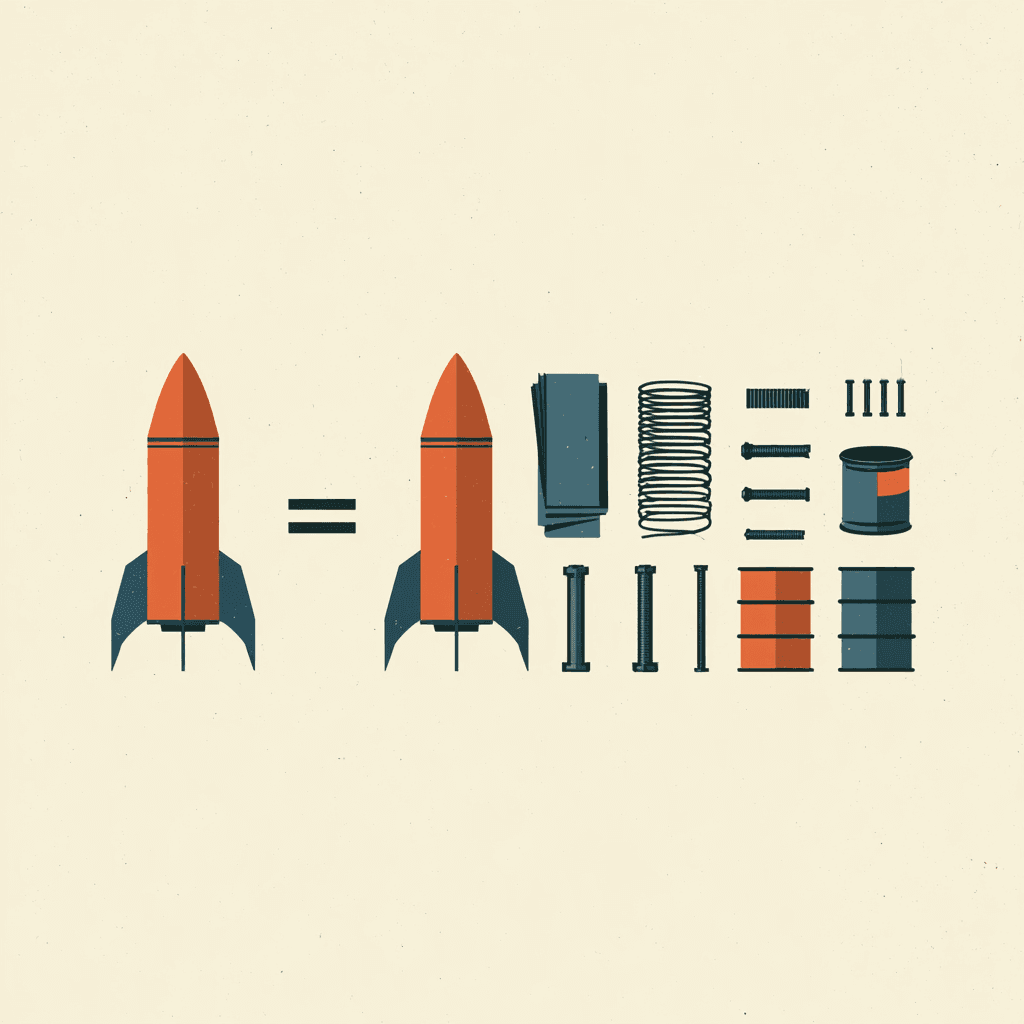
Elon Musk made first principles famous by refusing to accept what rockets cost. Instead of reasoning by analogy, rockets are expensive because rockets have always been expensive, he priced the raw materials: aluminum, titanium, copper, carbon fiber. They came to roughly two percent of a finished rocket's price. That gap between what everyone assumed and what was actually true became SpaceX.
You don't need a rocket company for this to pay off. The move is the same at any scale: keep asking why until the answers stop coming, then look at what you're standing on.
It's why I studied economics in college. I didn't love supply curves. I loved finding out how things actually work underneath the story everyone repeats about them. First principles thinking is just that instinct, given a method and a name.
And here's what discovering the name did for me: it turned something I did accidentally into something I can do on purpose.
What it unlocked for Coachstack
Anyone can build a website builder. Anyone can build a newsletter tool, a booking page, a lead magnet. In 2026, one person with an AI coding agent can build all four in a week. I know because I did.
That fact used to worry me. First principles turned it into clarity.
If the features are easy, the features aren't the value. So what is? I kept asking why until I hit bedrock. There are roughly 123,000 professional coaches in the world and the average one brings in about $49,000 a year from coaching, before expenses. Inside that average are people who are excellent at coaching and haven't made the leap, because nobody leaves a job without predictable income, and predictable income comes from a system that reliably produces clients, not a pile of tools that each do one thing well.
That's the first principle Coachstack sits on. Everything I build gets tested against it. Growth engine before back office. One flywheel instead of a feature list. A system a coach can build a life on, whether they're going all in or growing a practice alongside a job they love.
Knowing your first principle doesn't slow you down. It's the opposite. It tells you exactly where to move fast. Pricing, copy, onboarding order: reversible, ship it, learn. Anything touching the bedrock: worth every hour it takes. I've never felt more decisive than since I could tell those two apart.
The takeaway, if you want one
Try it on one decision this week. Take the problem in front of you and keep asking why until the answers run out. What you hit at the bottom is your first principle.
Then check: does what you're building still make sense sitting on top of it?
If yes, you just earned the confidence to move fast.
If no, you just found gold. Because now you know what to build instead.
See you next Saturday.
Peter
Not sure where you are stuck? Take the Get Unstuck quiz